
CAMINITO DEL REY HISTORY
Origin of the Caminito del Rey
El Caminito del Rey was originally built out of necessity during the Córdoba, Málaga railway construction. The Loring family, who held the railway concession, quickly saw the area’s potential for electricity generation. Engineer Rafael Benjumea Burín led the project. A hydroelectric company operated near the El Chorro and Gaitanejo waterfalls and needed a way to connect them. The goal was to allow worker access and move materials more easily.
Construction of the path began in 1901, starting near the railway tracks and running through the Desfiladero de los Gaitanes. Benjumea hired seafarers to build the wooden pathway and reach the area for maintenance tasks. This became the first section of today’s Caminito del Rey. The Sociedad Hidroeléctrica del Chorro completed the project in 1905. It was seen as an engineering feat and aimed to support local economic growth.

Alfonso XIII’s role in the Caminito del Rey
In 1921, King Alfonso XIII visited the area for the opening of the Conde del Guadalhorce reservoir. He was there to mark the placing of the final stone at the El Chorro dam. According to local stories, he didn’t walk the entire path. A stone seat, now called “El Sillón del Rey” (The King’s Armchair), remains as a reminder of his visit.
After that, locals began calling the walkway the “Caminito del Rey” – a name still used today. Over time, people from El Chorro and nearby villages used the path regularly. It became part of daily life for many local families.

Decay of the Caminito del Rey
Over the years, the Caminito del Rey began to decay. Exposure to sun, wind, and rain caused parts of the concrete path to crumble, leaving only the steel rails in some areas. By the late 20th century, the walkway had earned a reputation for being thrilling and challenging. Hikers and climbers were drawn to its dramatic cliffs and the excitement of navigating its rugged terrain. The path’s raw and wild state only added to its appeal. In the early 2000s, the trail was officially closed to the public for safety improvements. Still, its legendary status continued to grow, with stories of daring adventures keeping the spirit of the walkway alive. During the restoration, instead of removing the damaged original path, a new wooden boardwalk was carefully built just above it – allowing visitors to see the historic structure beneath their feet while walking safely along the cliffs.

A safe and stunning comeback
In 2014, a major restoration began to bring new life to the historic Caminito del Rey. The aim was to protect its heritage while making it completely safe for visitors.
What was done during the renovation:
- Damaged concrete paths were replaced with solid wooden walkways
- Reinforced steel supports were added for stability
- Safety railings and nets were installed to prevent accidents
The route officially reopened in March 2015. Thanks to the renovation, the Caminito del Rey is not just beautiful – it’s also extremely safe today.

Caminito del Rey: 7.7 kilometers of adventure
The trail starts in Ardales, near the El Kiosko restaurant. This is where visitors pick up their tickets and receive a safety helmet. From there, the route heads downhill for 7.7 kilometers, ending at El Chorro station in Álora. It usually takes 3 to 4 hours to complete. There are two ways to reach the Caminito del Rey footbridges. One is the Senda de Gaitanejo, a narrow 2.7-kilometer path through pine trees. The other is shorter, taking you through a small pedestrian tunnel and along the Pista de Gaitanejo (1.5 kilometers).
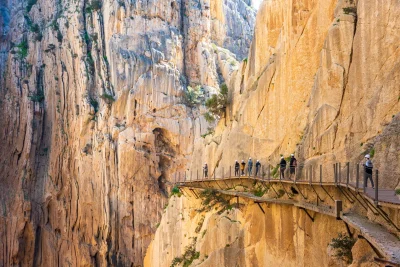
Both routes meet at the Visitor Reception Booth, near the old Electrical Substation. This is where the main trail begins. The next section includes 3 kilometers of walkways high above the ground, passing through historic hydroelectric areas. On the rock walls, you’ll see plaques showing the high water levels during floods in 1941 and 1949. The path goes through three dramatic gorges. First is the Gaitanejo Gorge, just 10 meters wide. Then comes the Tajo de las Palomas, with footbridges over a deep drop and several viewing points. Finally, the Gaitanes Gorge features narrow paths clinging to the cliffs and the famous Hanging Bridge, suspended 105 meters above the Guadalhorce River. The final stretch is a 2.1-kilometer descent to El Chorro railway station. It passes through the old village of El Chorro, once home to canal workers and hydroelectric plant staff.
Caminito del Rey today
Today, Caminito del Rey is one of Spain’s most popular outdoor attractions. The 7.7-kilometer route combines a scenic boardwalk with peaceful hiking trails through nature.
It’s a favorite spot for families, hikers, and adventurous travelers looking to explore the Gaitanes Gorge and the Guadalhorce River. With its dramatic views and well-maintained paths, it’s a great way to enjoy the outdoors in southern Spain.
Want to find out more about Caminito del Rey and its history?

Entry ticket included
Caminito del Rey Small Group Tour
See one of Spain’s most dramatic landscapes with the Caminito del Rey Small Group Tour! You’ll walk through staggering canyons, with cliffs rising over 400 meters above the river below. The footpath is fastened right against the rock walls, so you’ll have thrilling views all around you. A local guide will lead you through the ravine, teaching you the site’s history as you explore. Since you’ll be in a small group, make sure to ask your guide questions and learn from them - they’re at your disposal!

Roundtrip transportation
Caminito del Rey Tour from Málaga
Book the Caminito del Rey Tour from Málaga, and go on an adventure through soaring canyon walls! An air-conditioned bus will pick you up in Málaga, bringing you to the path’s starting point. From there, you’ll walk along an electrifying boardwalk, 100 meters above the ground. A local guide will accompany you, teaching you all about the pathway’s history. After you’ve walked the entire Caminito, enjoy a relaxing drive back to Málaga.